
CISM Exam Blueprint
How the CISM exam is structured, what each domain covers, and why weightage should drive your preparation strategy.
December 28, 2025 | Parul Sharma
If you are planning to give the CISM exam by ISACA, there are a few things you should know before you open a book or start watching videos. These are not preparation tips in the usual sense. They are orientation points that help you set the right mindset for the exam.
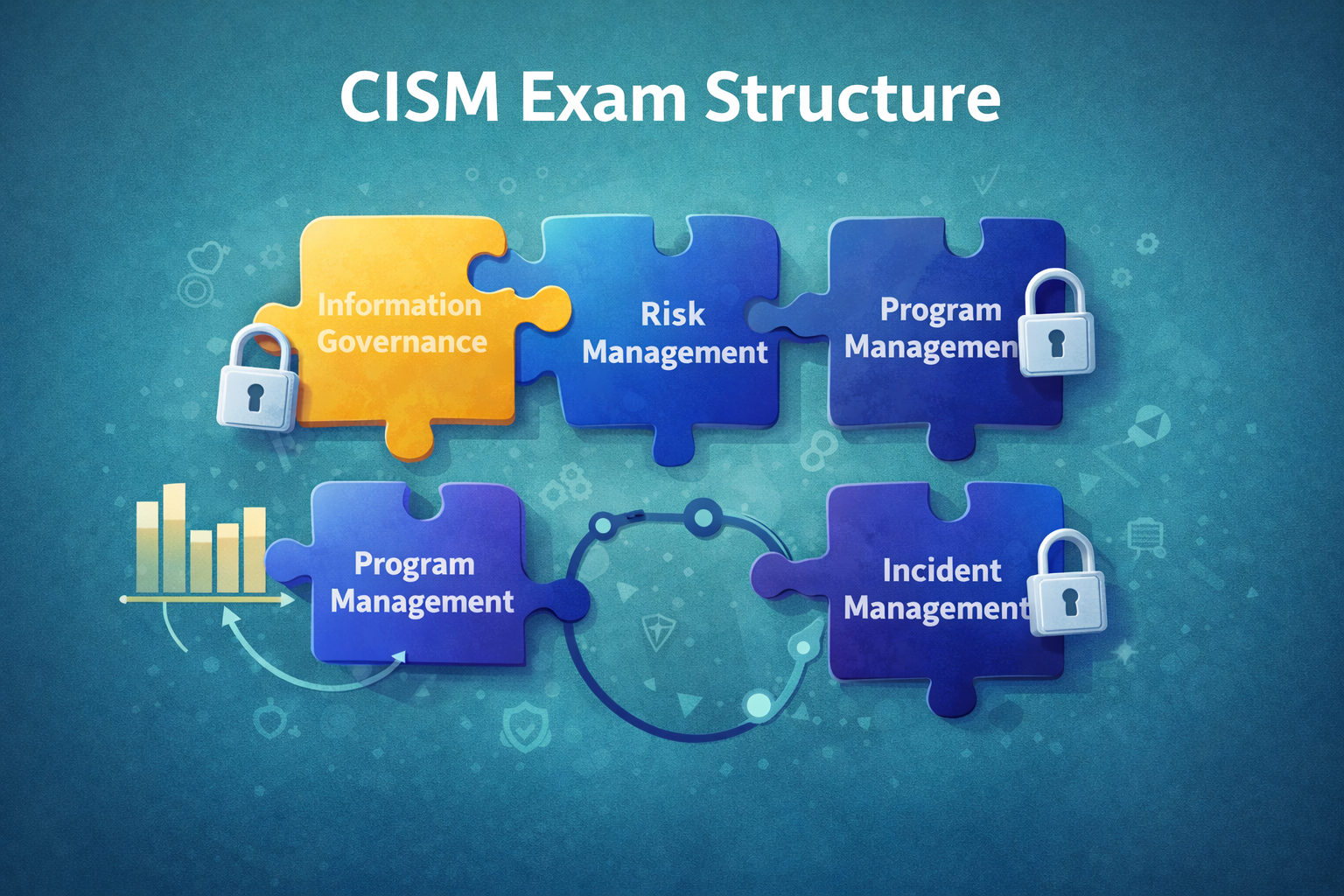
CISM is divided into four domains. These domains are not equal in importance, and ISACA is very explicit about that through exam weightage. Knowing this upfront matters because it directly affects how you should allocate your time and energy.
The four domains and their official weightage are:
This immediately tells you something important: Domains 3 and 4 together account for more than 60% of the exam. CISM does not reward equal effort across all topics. It rewards focus on how security programs are built, run, and responded to when things go wrong. Governance and risk provide the framing language, but the exam heavily tests execution and decision-making at program and incident level.
Understanding this early helps avoid a very common mistake—spending too much time perfecting governance theory while under-preparing for program and incident scenarios.
CISM can be taken in two ways: at an authorized exam center or as an online proctored exam from home. Both options are officially supported by ISACA.
In some regions, especially parts of Europe, exam centers may not always be available or conveniently located. In such cases, the online proctored option becomes very practical. The home-based exam is not a compromise or a second-tier option; it is a fully valid way to take the exam, provided you meet the technical and environmental requirements.
This flexibility matters more than people realize. It allows you to plan the exam around your life constraints instead of postponing it indefinitely due to logistics.
Another important point that many candidates don’t realize early enough is that buying the CISM voucher and booking the exam date are two separate steps.
You can purchase the exam voucher first and decide on the exam date later. This gives you flexibility. You are not forced to commit to a date before you feel mentally ready. For many working professionals, this reduces unnecessary pressure and allows preparation to stabilize before locking in the exam.
This approach also helps maintain momentum. Instead of rushing because a date is fixed too early, you can book the exam when you feel your understanding has reached a plateau and further preparation is unlikely to add much value.
Before going into preparation strategies, it helps to understand what each domain actually covers at a high level. This section is not about depth. It is about knowing the scope.
Align security with business objectives and establish governance structures.
Identify, evaluate, treat, and monitor information security risk.
Build, operate, and continuously improve the security program (largest domain).
Prepare, respond, recover, and learn from incidents.
At this stage, the goal is not to master any domain. The goal is to understand the map. Once you know what the exam is made of, how it is weighted, and how it can be taken, you can move into preparation with far fewer assumptions and far less anxiety.
In the next part, the focus shifts from structure to execution—how I actually prepared, how I allocated time across domains, and how my strategy changed as the exam approached.