GDPR
GDPR - The General Data Protection Regulation
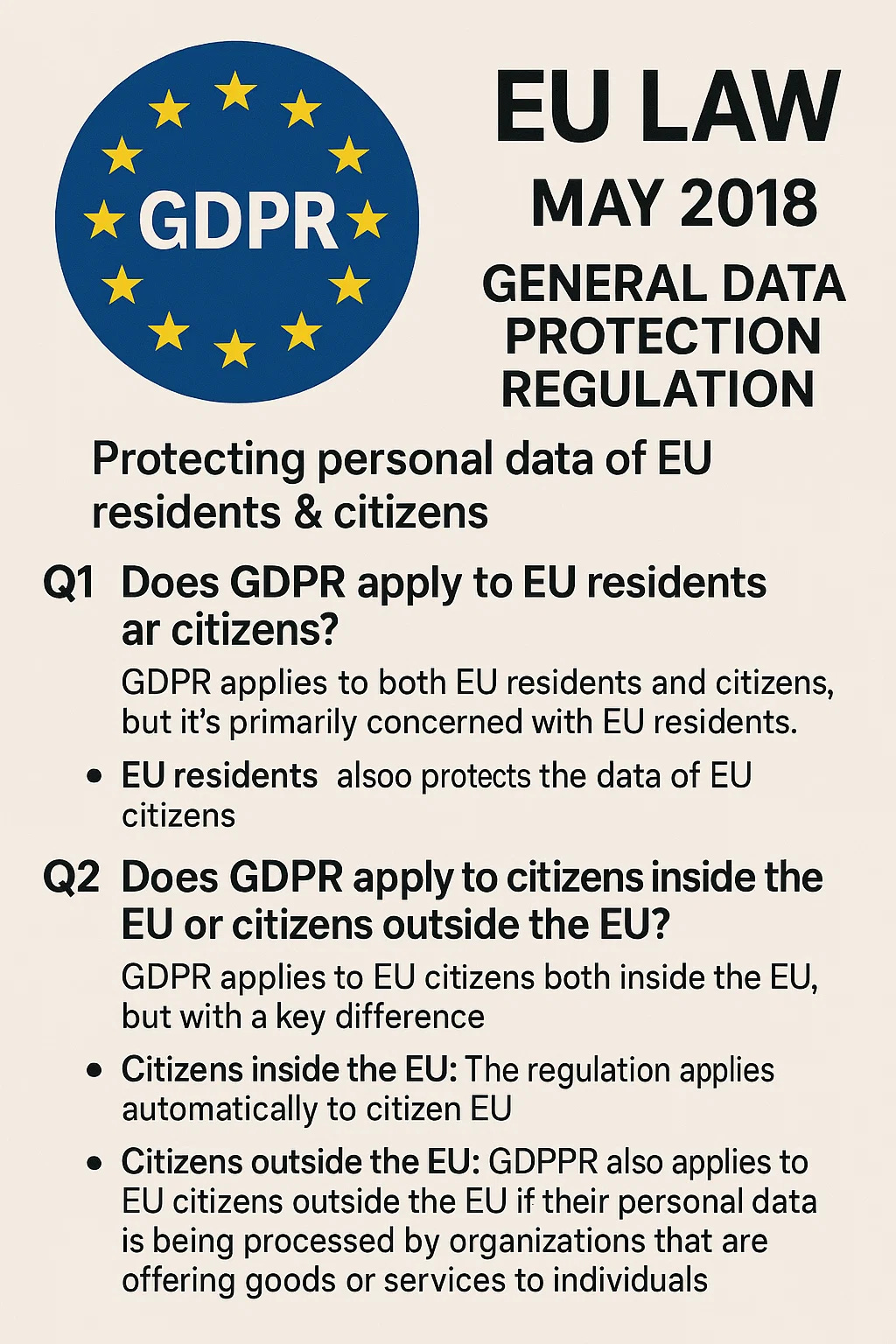
Came into force: May 2018
Jurisdiction: European Union (EU)
Purpose: Protect the
personal data of EU residents and citizens, both within and — under certain conditions — outside EU borders.
What GDPR Protects
-
Personal Data – any information relating to an identified or identifiable natural person (name, ID number, location data, online identifier, or factors specific to their identity).
-
Special Categories of Data – sensitive data such as racial/ethnic origin, political opinions, religious beliefs, health information, biometric data, and sexual orientation.
Who GDPR Applies To
GDPR has a territorial scope that goes beyond the EU’s physical borders.
1. EU Residents
-
If a person is living in the EU, GDPR applies to the processing of their personal data — regardless of nationality.
-
Example: An Australian living in Paris is protected by GDPR.
2. EU Citizens
-
GDPR also protects EU citizens even when they are outside the EU, if their personal data is processed in connection with:
-
An organization offering goods or services to individuals in the EU, or
-
Monitoring their behavior within the EU.
-
Example: A Spanish citizen living in Canada buys from an EU-based online store; GDPR applies to that transaction.
Key Principles
GDPR is built around
seven core principles that guide all processing activities:
-
Lawfulness, Fairness, Transparency – processing must have a legal basis, be fair, and clearly explain how data will be used.
-
Purpose Limitation – collect data only for specific, legitimate purposes.
-
Data Minimization – gather only the minimum data necessary for the purpose.
-
Accuracy – keep personal data up-to-date and correct inaccuracies promptly.
-
Storage Limitation – store data no longer than necessary.
-
Integrity and Confidentiality – protect data with appropriate security measures.
-
Accountability – be able to demonstrate GDPR compliance.
Data Subject Rights
GDPR grants individuals powerful rights over their personal data:
-
Right to Access – know what data is held about them.
-
Right to Rectification – correct inaccurate data.
-
Right to Erasure (“Right to be Forgotten”) – request deletion of their data.
-
Right to Restrict Processing – limit how data is used.
-
Right to Data Portability – obtain their data in a portable format.
-
Right to Object – stop processing based on certain grounds.
-
Rights related to Automated Decision-Making – safeguard against profiling without human intervention.
Obligations for Organizations
-
Lawful Basis for Processing – consent, contract, legal obligation, vital interest, public task, or legitimate interest.
-
Data Protection Officer (DPO) – mandatory for public authorities and certain high-risk processors.
- Data Breach Notification – must notify supervisory authority within 72 hours of becoming aware of a breach.
- Privacy by Design and Default – security and privacy must be built into systems from the start.
Penalties
-
Lower-tier: Up to €10 million or 2% of annual global turnover (whichever is higher).
-
Higher-tier: Up to €20 million or 4% of annual global turnover.
Neuromesh Example
Susan from HR sends Anya a product demo dataset containing
real customer records.
-
Even though it’s “internal,” GDPR still applies — there’s no internal-use exemption.
-
Without anonymization, Neuromesh risks regulatory fines, breach notification obligations, and reputational damage.
Marcus reminds Anya: GDPR isn’t just about avoiding fines — it’s about earning and maintaining customer trust by respecting their privacy rights.
Back to Case Studies